
When it comes to LED chip specifications, there are two “seesaws”: if you increase the color rendering index, luminous efficacy decreases; if you make the color temperature warmer, luminous efficacy also decreases. This isn’t because manufacturers are cutting corners—it’s determined by the laws of physics. Today, I’ll explain these two principles clearly.
1. The higher the CRI, the lower the luminous efficacy
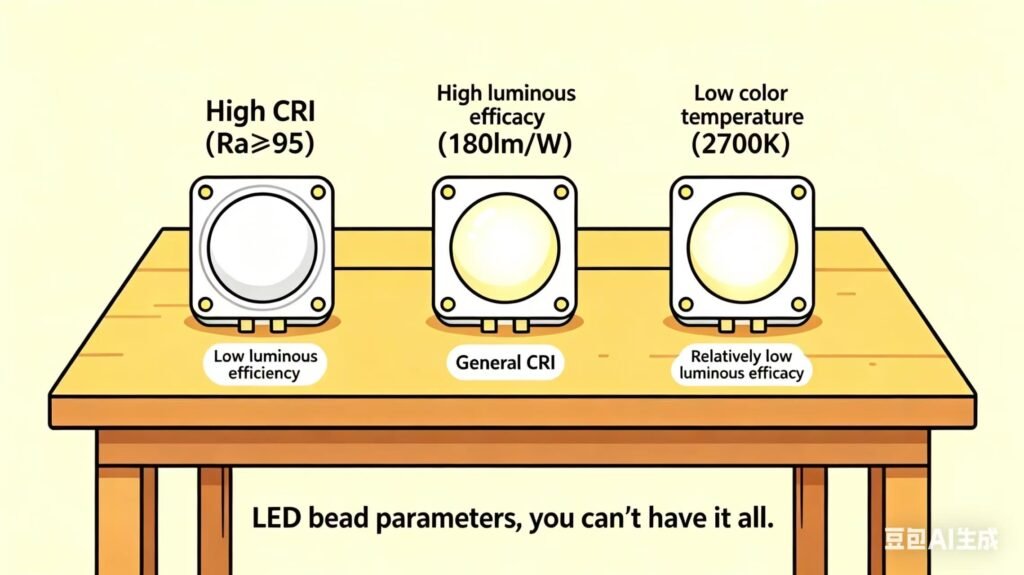
The most common configuration for LED chips is “blue light-emitting diodes (LEDs) combined with yellow phosphors.” When blue light strikes the yellow phosphors, it produces white light. However, the resulting light lacks red wavelengths in its spectrum, resulting in poor color rendering (Ra is typically only 70–80).
To improve color rendering, you need to add red to the spectrum. The standard approach is to use red phosphors. However, red phosphors have a much lower conversion efficiency than yellow phosphors. For the same blue LED chip, using yellow phosphors can produce 100 lumens of light, whereas switching to red phosphors may result in only 70–80 lumens. As efficiency drops, luminous efficacy decreases accordingly.
Given the same chip size and color temperature, increasing Ra from 80 to 90 results in a 10%–15% drop in luminous efficacy; beyond 90, each incremental increase comes at an even greater cost. This is not a manufacturing issue, but a physical limitation—the closer an LED’s spectrum is to sunlight, the more red component it requires, and red phosphors inherently have lower efficiency.
Simple conclusion: If you want true-to-life colors (high CRI), you have to accept a reduction in brightness.
2.The warmer the color temperature, the lower the luminous efficacy
Color temperature is also a key factor affecting lighting efficiency. White LED light is produced when blue light chips excite phosphors. The lower the color temperature (the warmer and more yellow the light), the higher the proportion of yellow and red phosphors required. However, these long-wavelength phosphors inherently have lower conversion efficiency than short-wavelength ones.
In addition, the human eye has varying sensitivity to different wavelengths of light. It is most sensitive to 555-nanometer light (yellow-green light) and less sensitive to both red and blue light. In the spectrum of light with a low color temperature, the yellow-green component is relatively low, while the red component is high. For the same radiant power, the human eye perceives a lower brightness. Since luminous efficacy is calculated based on the brightness perceived by the human eye, light with a low color temperature is inherently at a disadvantage in terms of luminous efficacy.
Given the same chip size and color rendering index, the 2700K has 15%–20% lower luminous efficacy than the 6500K. In other words, warm-toned lights are inherently dimmer than cool-white lights; it’s not that the bulbs are inferior, but rather that the human eye is less sensitive to warm light. The simple conclusion is this: if you want a cozy atmosphere (low color temperature), you’ll have to accept slightly lower brightness.
3. How to choose? Choose based on the situation
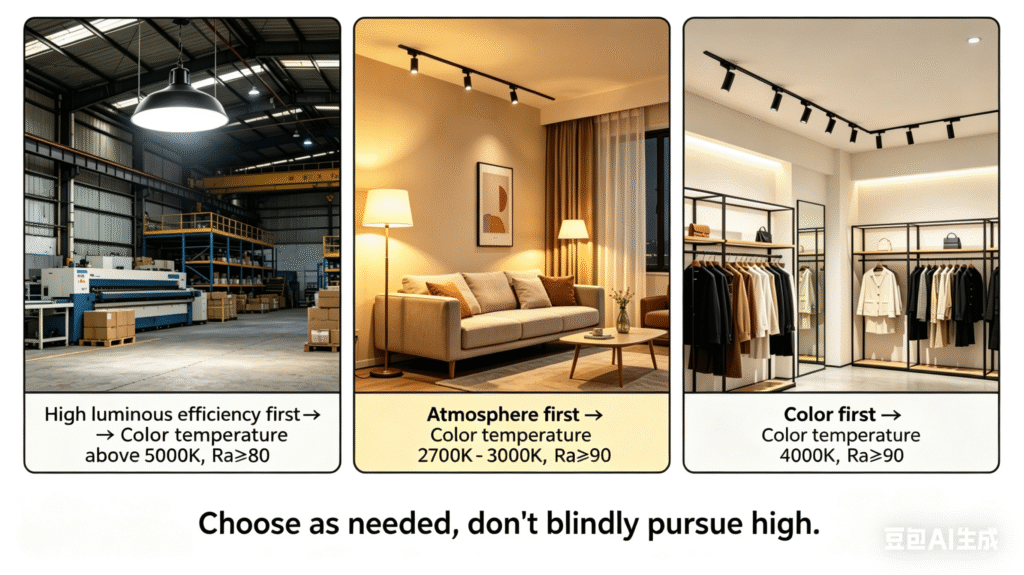
Once you understand these two principles, choosing the right lighting becomes a breeze—there’s no such thing as a “one-size-fits-all” light; there’s only the most suitable one.
Warehouses, roads, and parking lots: Choose high-efficiency products (color temperature 5000K or higher, Ra ≥ 80). Brightness and energy efficiency are the top priorities; color and ambiance are secondary.
Residential, restaurants, hotels: Choose products with low color temperature and high CRI (color temperature 2700K–3000K, Ra ≥ 90). Atmosphere and comfort are the top priorities; slightly lower brightness is acceptable.
Offices, classrooms: Choose balanced products (color temperature 4000K–5000K, Ra ≥ 90). Both visual clarity and comfort are required, with a balance between CRI and luminous efficacy. Museums, high-end commercial lighting: Choose products with exceptional color rendering (color temperature 3000K–4000K, Ra ≥ 95). Color accuracy is the core requirement, while luminous efficacy and cost are secondary considerations.
Summary:
Given the same chip size, there are two physical principles governing LED chips: the higher the CRI, the lower the luminous efficacy (as compensating for red light reduces efficiency); and the lower the color temperature, the lower the luminous efficacy (since the human eye is less sensitive to warm light). Remember: there is no such thing as a perfect light. First, clearly identify the core requirement for the space—whether it’s brightness, ambiance, or color accuracy. By weighing these factors against your needs, you can select the product that’s truly right for the job.
When choosing lights, would you accept lower brightness in exchange for a higher CRI or lower color temperature?
A: Yes, atmosphere and color are more important
B: No, brightness comes first
C: It depends on the project; different scenarios call for different trade-offs
Share your thoughts in the comments section.